
Jeffrey Alston’s Family Fantasy
A Killer’s MindJeffrey Alston’s longing for companionship hardens into a coercive fantasy of permanent family life, exposing how his need for control turns imagined love into captivity and violence.
increasing Bearing strength in each event
 decreasing
Bearing strength in each eventdecreasingA Childhood Without Choice
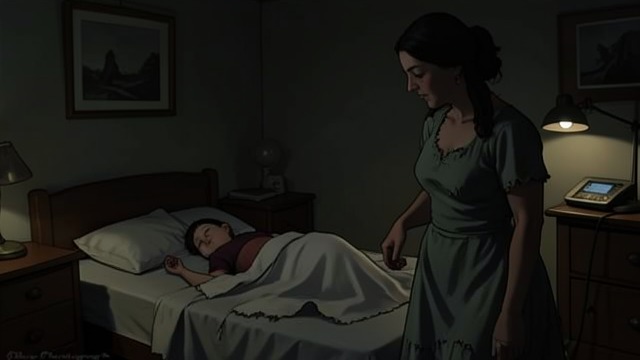
A Childhood Without Choice
A violent household
A neighbor recalls that Jeffrey Alston and his brother grew up under Bertha Alston’s abuse. When drunk, she screamed, threw things, and once tried to set one of her sons alight. Her daughter died young, and Bertha kept the body in the house for more than a week, locking the boys inside and telling them their sister was merely resting.
Death as enforced companionship
The boys were made to remain beside their dead sister while the body decomposed. For Jeffrey, the episode offers a disturbing context for his later fixation on dead women: a corpse had been made part of family life, while the living children had no power to leave or change what was happening. The experience does not excuse his later crimes, but it reveals a possible origin for his association between death, permanence, and domestic closeness.
The story also complicates any easy contrast between a “normal” brother and a killer. Both sons endured the same house, but their adult lives diverged. Jeffrey’s fate is shaped not only by childhood trauma but by the choices he makes to reproduce control rather than resist it.
The Woman Who Stayed
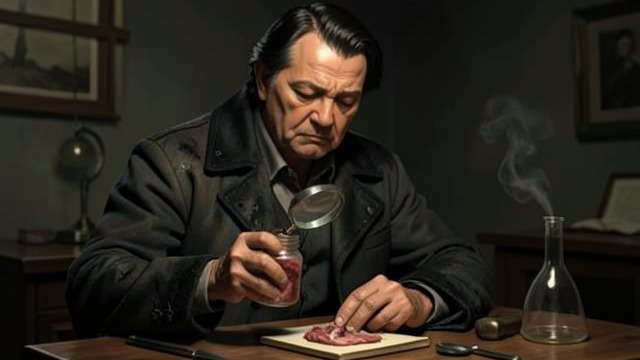
The Woman Who Stayed
An imagined domestic life
Jeffrey’s earlier murder of Veronika Murray becomes, in retrospect, a formative rupture in his criminal development. He kills his brother Clifford Sorenson’s fiancée and keeps her body, but its decay eventually forces him to discard it. The loss does not end his attachment to the fantasy of a dead companion; it sharpens the problem he wants to solve.
Preservation as a solution
After Veronika’s body decays, Jeffrey begins experimenting with animal remains and later teaches himself embalming. The sequence suggests that preserving a body is not simply a technical obsession: it is a way to extend the time he can imagine living alongside someone who cannot leave or contradict him. The initial failures and later refinements show him turning a private fantasy into a repeatable method.
What he calls permanence is the removal of another person’s agency. His imagined relationship depends on a partner who cannot answer, refuse, or depart. In this sense, the technical learning that makes his crimes more sophisticated also makes the violence more thoroughly organized around control.
A Romance Made of Poses

A Romance Made of Poses
Staging a partnership
Jeffrey kills Susan Warner, then begins taking vulnerable women from the street, including Monique Silva and Krista Barker. He embalms them, dresses them, and positions them in public as if they were inhabiting scenes from an ordinary relationship. A ring, formal clothing, and gestures of apparent sadness make the bodies seem to belong to a story of courtship and abandonment.
The fantasy’s limits
Jeffrey experiences each woman as a partner for a time, but the playacting eventually empties out and he decides the relationship has failed. He leaves the body in a pose that represents heartbreak, then returns to loneliness and searches for another woman. What he treats as a sequence of romances is a succession of murders, with every “breakup” imposed on a victim who never had the power to consent.
The poses reveal more than a wish to preserve bodies. They show Jeffrey trying to borrow the visible language of intimacy while rejecting the mutuality that makes intimacy real. Each carefully arranged scene is an effort to turn domination into a story he can bear to inhabit.
The Family Expanded
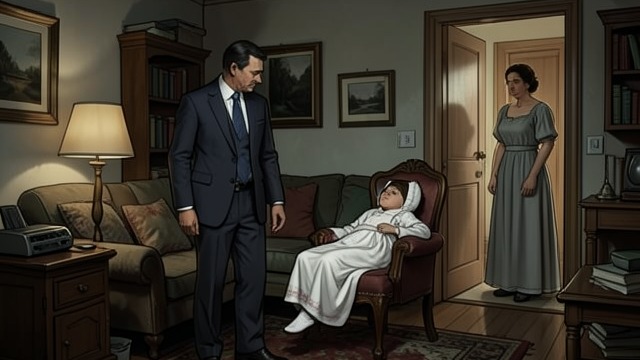
The Family Expanded
From partner to household
After the failed rescue of Lily Ramos and the police response, Jeffrey turns away from prostitutes and begins imagining a family instead. He watches a single mother and her children, picturing himself as a father who would never repeat his own mother’s cruelty. The children would remain with him, love him, and never grow up into independent adults who could leave.
A domestic fantasy becomes an attack
Jeffrey approaches the household under the pretense of answering a service request and forces his way inside. He binds the mother and children, deciding that he wants the daughter as part of his imagined family but initially sees no place for the boy. He considers killing the child, then hesitates because he has never embalmed a child and might damage the fantasy by failing at the process.
The escalation exposes the danger in Jeffrey’s idea of family: every person in it is assigned a role without consent, and any independent desire becomes an obstacle. His history is not repeating itself mechanically; he is actively reproducing the same captivity that marked his childhood, now as the person holding power.
The Fantasy Interrupted
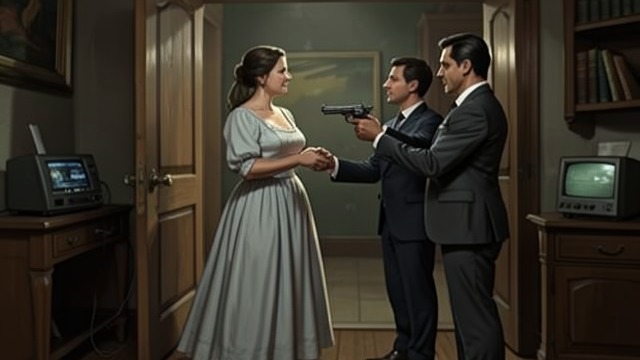
The Fantasy Interrupted
A confrontation over control
Tatum reaches Laura Summer’s home while Jeffrey is strangling her and holding her as a shield. Zoe enters and recognizes that a direct appeal to reason is unlikely to change his behavior. She instead speaks to the fantasy beneath it, presenting herself as a willing, permanent companion and describing the domestic life he imagines.
Arrest and exposure
As Jeffrey becomes absorbed in the promise of a relationship he can control, Zoe moves toward Tatum, who places handcuffs on her. She uses the staged surrender to create an opening, then dives clear as Tatum shoots Jeffrey. Laura and her children survive, and the police take the wounded killer into custody.
The fantasy that had organized Jeffrey’s life is broken by the agency he had tried to erase in others. Zoe’s performance manipulates his delusion, but it does not validate it: the household he wanted was built through threats, restraint, and murder. His capture ends his immediate access to new victims, while leaving the damage to his surviving victims and family behind.
Late July 2016, as Tatum and Zoe investigate the Alston family
2014, before the animal-preservation reports begin
April–July 2016, during the first three Chicago murders
Late July 2016, after the attempted abduction of Lily Ramos
Late July 2016, at Laura Summer’s home
